 By
By The Strait of Hormuz — the world’s most critical oil chokepoint — just got a new rulebook. Iran’s Islamic Revolutionary Guard Corps (IRGC) released a redrawn map of control over the waterway on May 4, 2026, expanding what Tehran considers its operational zone far beyond historical boundaries. The move has sent shockwaves through global energy markets, shipping circles, and military planners from Washington to Riyadh.
Here is what changed, why it matters, and what the world is watching next.
Background: How the Strait of Hormuz Crisis Began
The current Strait of Hormuz crisis did not appear overnight. It has roots in one of the most dramatic military events of 2026.
On February 28, 2026, the United States and Israel launched coordinated airstrikes on Iranian military and government targets. The strikes killed Supreme Leader Ali Khamenei and other senior Iranian officials. Tehran responded immediately — closing the Strait of Hormuz to all foreign shipping and launching missile and drone attacks on Israel, US military bases, and US-allied Gulf states.
The IRGC issued VHF radio warnings to vessels in the strait: “No ship is allowed to pass the Strait of Hormuz.” Though the Royal Navy noted the closure was not legally binding under international maritime law, the practical danger was real. Iran deployed mines, fast-attack boats, and drones to enforce its blockade.
By mid-March, the US military launched an aerial campaign against Iranian naval targets to force the waterway back open. That campaign eventually escalated into a naval blockade of Iranian ports, effective April 13, after peace talks in Islamabad collapsed.
What Iran’s New IRGC Map Actually Shows
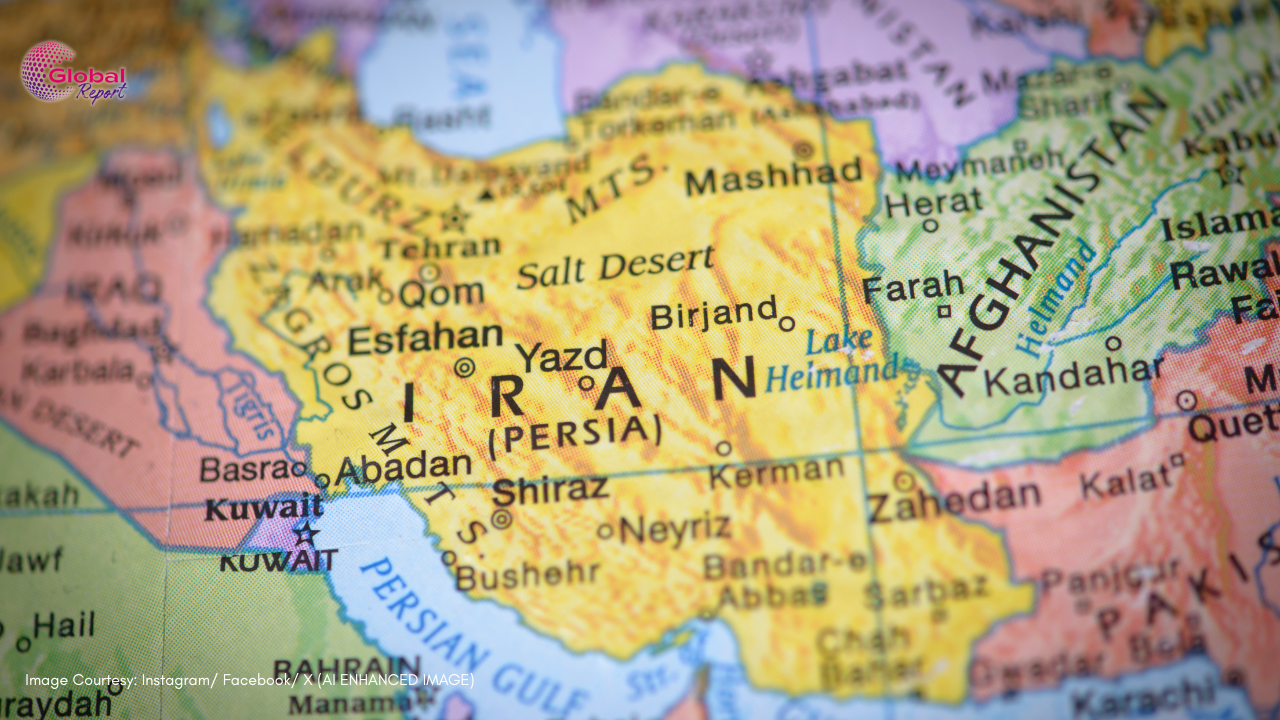
The IRGC’s Sepah News outlet published the new control map on May 4, 2026, alongside a warning: any vessel that fails to comply with Guard naval directives would face “serious risks.”
The newly defined zone covers a significant stretch of the Gulf of Oman and Persian Gulf. The boundaries run:
- Western line: From the tip of Iran’s Qeshm Island to the UAE emirate of Umm al-Quwain
- Eastern line: From Kuh-e Mobarak (Mount Mobarak) in Iran to south of Fujairah in the UAE
IRGC spokesman Hossein Mohebi claimed the announcement did not represent a change in the overall management of the waterway. Iran’s foreign ministry echoed that Iran considers itself “the guardian and protector of the Strait of Hormuz.”
But analysts and shipping industry officials read the map differently. The zone as drawn encapsulates a vast section of the UAE’s Gulf of Oman coastline — territory that Iran has never formally claimed to control before.
Deputy Commander of the IRGC Navy: “The area of the Strait of Hormuz has become larger.”
In the past, the Strait of Hormuz was defined as a limited area around islands such as Hormuz and Hengam. However, under the new plan, the operational scope of the Strait of Hormuz has… pic.twitter.com/vohPYmxlvO
— Iran Screenshot (@iranscreenshot) May 12, 2026
5 Alarming Shifts in Iran’s Redefined Zone
1. The Strait Is Now Claimed to Be 200–300 Miles Wide
This is the biggest number in the story. Iranian news agencies Fars and Tasnim reported on May 12 that Iran now considers the Strait of Hormuz to be 200 to 300 miles wide — compared to the 20 to 30 miles that was the previously accepted estimate.
Mohammad Akbarzadeh, deputy political director of the IRGC Navy, confirmed the expansion to Reuters. “In the past, the Strait of Hormuz was defined as a limited area around islands such as Hormuz and Hengam, but today this view has changed,” he said. The expanded zone now forms what Iranian media called a “complete crescent.”
2. Iran Now Claims Control Over UAE Coastline
The new map places the eastern boundary of Iran’s claimed control zone at the south of Fujairah — a port city and emirate in the UAE. The western boundary runs from Qeshm Island to Umm al-Quwain, another UAE emirate.
This is a direct assertion of military jurisdiction over waters adjacent to sovereign UAE territory. Tehran and Abu Dhabi are already at odds. Iran’s foreign ministry accused the UAE of “alignment with the aggressors” — a reference to the US and Israel — and warned that this had “created many problems.”
3. Commercial Vessels Must Now Coordinate With Iran
Any ship wishing safe passage must now coordinate with Iranian military authorities along designated routes. The IRGC stated that vessels following its transit protocols would be permitted through — but that compliance is mandatory, not optional.
Hapag-Lloyd, one of the world’s largest shipping groups, said transit remained “impossible” as of early May due to a lack of clarity on secure passage procedures. BIMCO, the global shipping industry association, warned bluntly: without Iran’s consent, it is unclear whether the threat to ships can be “degraded or suppressed” at all.
4. The Humanitarian Toll Is Already Severe
The International Maritime Organization confirmed that hundreds of commercial vessels and up to 20,000 seafarers are trapped in the strait due to the ongoing conflict. At least 17 merchant ships have been damaged, seven abandoned, and two captured. A tugboat has been sunk. Twelve seafarers are dead or missing.
US Secretary of State Marco Rubio said in early May that 10 civilian sailors had died due to the conflict. The US Navy has destroyed seven Iranian fast boats in the waterway.
5. The US-Led Response Has Already Stalled
The US military launched “Project Freedom” on May 4, a defensive escort operation designed to move stranded commercial vessels safely through the strait. Within 24 hours, the operation was paused — after Pakistan and other nations appealed for a diplomatic pause, and Trump announced that “great progress” had been made toward a final agreement with Iran.
The US-led Joint Maritime Information Center still rates the maritime security threat level in the Strait as “critical.”
Shipping in Freefall: The Human and Economic Cost
The Strait of Hormuz normally carries roughly one-fifth of the world’s oil and liquefied natural gas supply. It is the sole maritime exit route for major exporters including Saudi Arabia, Iraq, and Qatar.
Since February 28, that flow has largely stopped. The US naval blockade of Iran — costing Tehran an estimated $500 million per day according to US officials — has further strangled the region’s maritime trade in both directions.
Only token traffic moved through the strait in early May. MarineTraffic data showed a single sanctioned LPG carrier and a few cargo ships passing through on May 4. No tankers were queuing to transit. Commodity prices globally have moved sharply as a result of the supply disruption.
The IMO and BIMCO have both called for urgent diplomatic resolution. The shipping industry needs legal clarity that Iran will not attack compliant vessels — and neither US military escorts alone nor the threat of force appears to be delivering that clarity.
The US Response: Project Freedom and a Naval Blockade
CENTCOM launched Project Freedom as the second phase of US military engagement in the region. Defense Secretary Pete Hegseth described it as “defensive in nature, focused in scope, temporary in duration — with one mission: protecting innocent commercial shipping from Iranian aggression.”
The operation combined escorted transits with continued aerial and naval pressure on Iran. The US had already dropped bunker-buster bombs on Iranian anti-ship cruise missile sites along the strait in March and sank 16 Iranian minelayers as Iran was mining the waterway.
Despite these efforts, no significant vessel traffic materialized on May 4. Iran warned the US Navy directly to stay out of the strait. The US-led Joint Maritime Information Center advised mariners to consider routing through Omani territorial waters south of the traffic separation scheme — a workaround, not a solution.
Project Freedom was paused on May 5 after Trump announced it on Truth Social, citing diplomatic progress. But Trump also warned that bombing would resume if Iran failed to agree to his terms — though those terms were not publicly defined.
What This Means for Global Oil and Energy Security
This crisis is not just a regional military standoff. The Strait of Hormuz is the single most important maritime chokepoint in the global energy system. There is no fully functional alternative route for the volume of oil that normally transits through it.
The IRGC’s expanded map sends a clear strategic message: Iran views its control over the strait not as a temporary wartime measure but as a permanent feature of its military posture going forward. The “complete crescent” framing — a zone 200 to 300 miles wide, encompassing UAE coastline — is a significant territorial assertion that will complicate any post-conflict normalization.
For energy importers in Asia, Europe, and beyond, the practical question is duration. Every week the strait remains effectively closed adds pressure to oil prices, shipping insurance costs, and global supply chains. LNG markets, already tight, face particular strain as Qatar’s export capacity is constrained by the situation.
The UAE’s position is particularly sensitive. Abu Dhabi relies on the strait for its own energy exports, yet Iran has accused it of siding with adversaries. Oman, which has historically played a mediating role between Iran and the West, has allowed CENTCOM to route some maritime traffic through its territorial waters — a practical workaround that does not resolve the core standoff.
Key Takeaways
- Iran’s IRGC redrew its Strait of Hormuz control map on May 4, 2026, expanding the claimed zone to 200–300 miles wide
- The move follows the US-Israel attack on Iran in February and the subsequent closure of the strait
- Hundreds of ships and 20,000 seafarers remain stranded; 12 seafarers are dead or missing
- The US launched and quickly paused “Project Freedom” — a military escort operation for commercial vessels
- A diplomatic resolution remains uncertain, with Iran and the US still exchanging positions through intermediaries
- Global oil and LNG markets face sustained disruption until the waterway reopens
Frequently Asked Questions
Q: Why is the Strait of Hormuz so important to global energy markets? A: The Strait of Hormuz carries approximately one-fifth of the world’s oil and liquefied natural gas supply. It serves as the primary maritime export route for Saudi Arabia, Iraq, Qatar, Kuwait, and the UAE. There is no viable alternative route capable of handling a similar volume of energy traffic.
Q: What is Iran’s legal basis for claiming control over the Strait of Hormuz? A: Iran does not have internationally recognized legal authority to close or control the strait for general international shipping. Under the United Nations Convention on the Law of the Sea, vessels have the right of transit passage through international straits. However, Iran disputes elements of this framework and has enforced its blockade militarily regardless of legal objections.
Q: What is Project Freedom and has it reopened the strait? A: Project Freedom is a US military operation launched on May 4, 2026, to escort commercial vessels safely through the blocked Strait of Hormuz. The operation was paused within 48 hours after diplomatic pressure from Pakistan and others. As of mid-May 2026, the strait has not fully reopened to normal commercial traffic.
Q: How many ships and sailors are stranded in the Strait of Hormuz? A: The International Maritime Organization confirmed that hundreds of commercial vessels and up to 20,000 seafarers are unable to transit the waterway due to the ongoing Iran conflict. At least 12 seafarers are dead or missing, and at least 17 merchant ships have been damaged.
Q: What does Iran’s new IRGC map mean for the UAE? A: The new map places parts of the UAE’s Gulf of Oman coastline within Iran’s claimed zone of control — a significant territorial assertion. Iran has also accused the UAE of aligning with adversaries (the US and Israel), straining bilateral relations at a moment when Abu Dhabi depends heavily on the strait remaining open for its own energy exports.
Iran’s redrawn Strait of Hormuz map is more than a military display — it is a statement of intent. The IRGC has formally expanded what it considers its operational zone to a scale that dwarfs previous definitions, covering UAE coastline and claiming jurisdiction over a waterway through which one-fifth of global oil flows.
The world cannot afford a prolonged closure of the Strait of Hormuz. Markets, shipping companies, and governments from Tokyo to London are watching the US-Iran diplomatic back-and-forth with growing anxiety. Whether Project Freedom restarts, stalls, or gives way to a negotiated settlement will determine how long this crisis — and its economic fallout — continues.
Follow the latest developments on the Strait of Hormuz crisis at Global Report Online for real-time coverage and analysis.