
 By
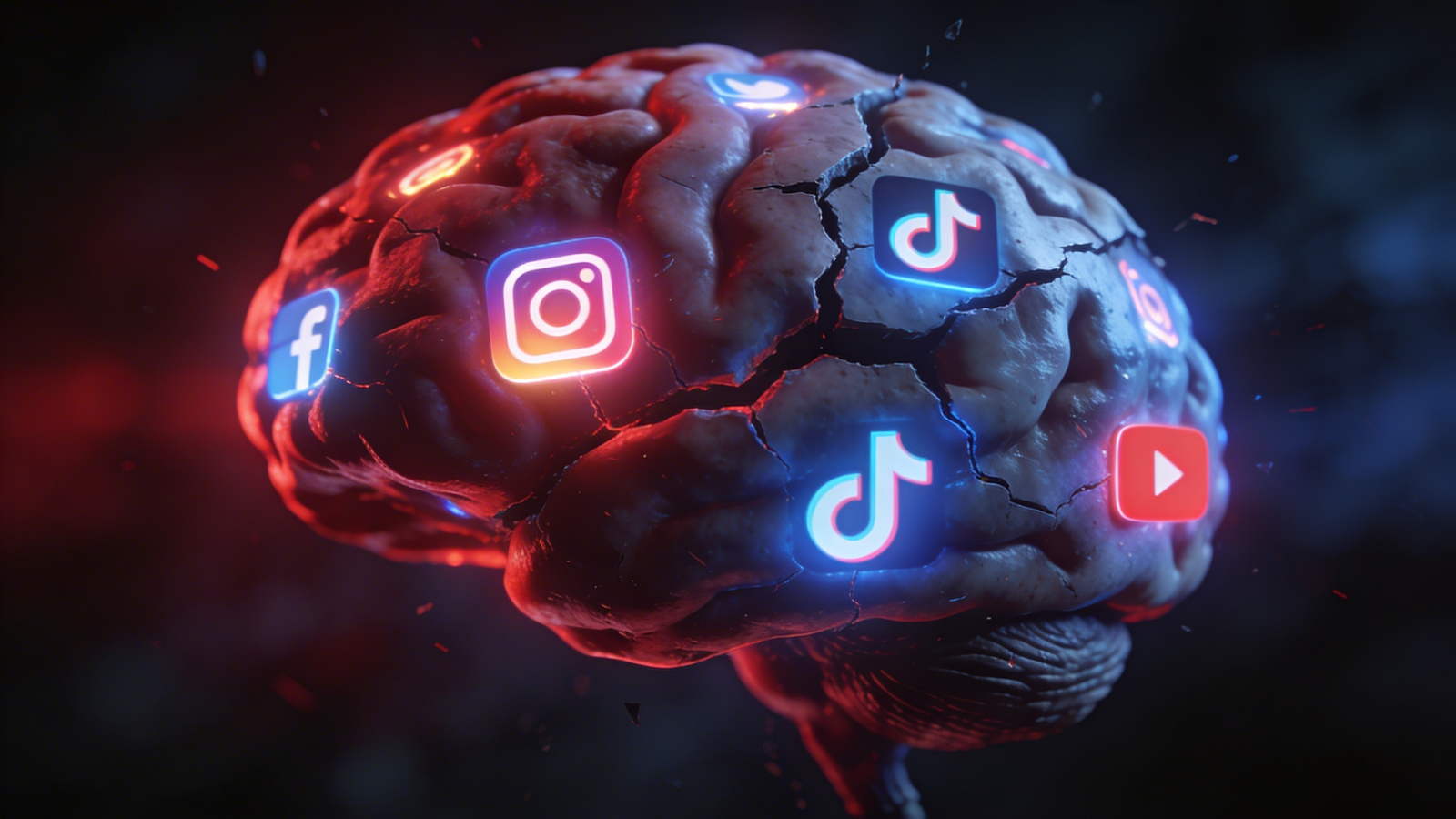
By New research confirms what many suspected: social media brain damage is real — and it may have set your mind back by a decade. But scientists also say the fix is simpler than you think.
What Is Social Media Brain Damage?
The term sounds extreme. The science backs it up.
A growing body of research now links heavy social media and smartphone use to measurable cognitive decline — specifically in attention span, memory, and focus. In some studies, the effects resemble accelerated brain aging.
The average American spends roughly 4.5 to 5 hours on their phone each day. Even at a conservative 2 to 3 hours daily, that totals nearly one and a half months of lost time every year — time that would otherwise go toward sleep, relationships, and cognitively stimulating activity.
This isn’t just about distraction. Researchers say social media brain damage manifests as a real, documented shift in how the brain processes information and sustains attention.
The Study That Changed Everything
A landmark study published in PNAS Nexus is reshaping how scientists understand the long-term effects of smartphone use.
The study involved more than 467 participants with an average age of 32. For 14 days, they used a commercially available app called Freedom to block internet access on their phones. Calls and text messages remained available — essentially reducing a smartphone to a basic phone.
The results were striking. Their time online dropped from 314 minutes to 161 minutes per day. By the end of the two-week period, participants showed measurable improvements in sustained attention, mental health, and self-reported well-being.
The most headline-worthy finding? The improvement in sustained attention was equivalent to reversing 10 years of age-related cognitive decline.
Noah Castelo, an associate professor at the University of Alberta School of Business and one of the study’s authors, said the research grew out of his own lived experience. He noted how smartphones began reshaping his daily habits after college — quietly crowding out activities that were otherwise engaging, like shared meals with friends.
How a 2-Week Digital Detox Reverses the Damage
The concept of a digital detox often gets dismissed as a wellness trend. This study suggests otherwise.
The effect of the intervention on depression symptoms was found to be larger than antidepressants and comparable to the impact of cognitive behavioral therapy. That is a significant finding from a relatively short, low-cost intervention.
What surprised researchers further was the behavior of participants who broke the rules. Even those who did not fully comply with the detox and cheated after a few days still showed positive effects. In follow-up reports, many participants noted that the benefits persisted well after the two weeks ended.
Kostadin Kushlev, an associate professor of psychology at Georgetown University and a co-author of the study, put it plainly: you do not need to restrict yourself permanently. Even a partial digital detox, even for a few days, appears to produce meaningful results.
Researchers also drew a clear distinction between phone-based internet use and computer-based use. Phone use was described as more “compulsive and mindless.” Unlike computers, phones allow — and encourage — social media browsing during walks, conversations, meals, and movies, constantly interrupting other activities.
Researchers found that even a small amount of phone-related distraction during social activities reduced attention to and enjoyment of those activities — leading to less satisfying conversations and weaker relationship quality.
The Mental Health Numbers Are Alarming
The PNAS Nexus findings are not an outlier. A separate Harvard study published in JAMA Network Open tracked nearly 400 people through just one week of reduced smartphone use.
After just seven days, participants reported a 16.1 percent drop in anxiety, a 24.8 percent reduction in depression symptoms, and a 14.5 percent decrease in insomnia.
These are not marginal improvements. They represent a clinically meaningful shift — achieved through behavior change alone, with no medication, no therapy, and no cost.
Other experiments point in the same direction. Whether the approach involved cutting social media use by one hour per day for a week or stepping away from just Facebook and Instagram, the pattern held. Reducing screen time produced measurable mental health benefits.
The scale of the problem has also drawn government attention. Australia has moved to limit social media access for children and teenagers, and similar proposals have emerged in parts of Europe and the United States.
Meanwhile, the legal system is catching up. A 20-year-old woman recently testified in a landmark California trial against Meta and YouTube, describing how social media had consumed her life from childhood — expanding to fill every available hour, displacing sleep, and intensifying anxiety, depression, and body image distress. The jury found both companies negligent and ordered them to pay $6 million in damages. A parallel case in New Mexico reached a similar verdict in March.
Meta has said it takes steps to protect young users and announced plans to appeal. YouTube also denied the characterization of its platform and said it would appeal.
Not Everyone Is Affected the Same Way
Researchers are careful to note that social media brain damage does not affect all users equally.
John Torous, an associate professor and staff psychiatrist at Harvard Medical School who led the JAMA Network Open study, describes the research landscape as a “Goldilocks problem.” For some people, their smartphone use is too much or too little. For others, it is just right. Identifying who is most harmed — and why — remains a critical research priority.
Torous and his team are studying several high-risk groups. These include people prone to social comparison — those who measure their worth against others, particularly around physical appearance. They also include users whose sleep is regularly disrupted by device use, and those who turn to the internet to compensate for a lack of real-world connection.
A much larger study is now underway to probe these questions at scale. Led by Steven Rathje, an incoming assistant professor of computer science at Carnegie Mellon University, the study spans more than 8,000 participants across 23 countries. Participants are asked to limit their use of TikTok, Instagram, X, and Facebook to no more than five minutes per app per day for two weeks. Results are expected in early 2027.
One emerging pattern from earlier research: the United States and other Western countries appear to experience more severe negative effects from smartphone use. One proposed explanation is cultural — life in highly individualistic, competitive societies may amplify the psychological toll.
That theory aligns with existing research showing anxiety disorders are more prevalent in high-income countries than in lower-income ones.
What You Can Do Right Now
The science is clear: reducing screen time produces measurable cognitive and mental health benefits. The intervention does not need to be total or permanent.
Here are four evidence-backed steps to start reversing social media brain damage today:
1. Try a 14-day phone detox. Use an app like Freedom to block social media and internet browsing on your phone. Calls and texts are fine. The research shows two weeks is enough to produce significant improvement in attention and mood.
2. Set daily time limits. If a full detox feels unrealistic, limit your use to 30–60 minutes per day on social platforms. Even a one-hour daily reduction showed benefits in multiple studies.
3. Make your phone dumb during social activities. Put it away during meals, conversations, and exercise. Research shows that even passive phone presence — phone on the table, not in hand — reduces the quality of real-world interactions.
4. Track your screen time honestly. Most people underestimate how much time they spend on their phones. Use your device’s built-in screen time tracker to establish a baseline before making changes.
The cognitive effects of heavy smartphone use are real and documented. But so is the brain’s capacity to recover. A short, deliberate digital detox may be one of the most effective and underused tools for protecting long-term mental health.
Start your digital detox today — your brain’s future self will thank you.
#SocialMediaDetox #DigitalDetox #BrainHealth #MentalHealthAwareness #ScreenTimeDetox


