
 By
By NASA‘s Artemis II crew has returned safely to Earth, completing the first crewed journey around the Moon in over 50 years. The mission marked a defining moment in space exploration history — and the world is still processing what just happened.
The Splashdown That Stopped the World
The Orion spacecraft carrying the Artemis II crew splashed down in the Pacific Ocean off the coast of California at 5:07pm local time on Friday. Recovery teams were already in position, moving quickly to secure the capsule and bring the crew safely aboard the US Navy recovery ship.
The return was anything but simple. The capsule endured a dramatic 13-minute descent, slamming into the atmosphere at extreme speed, with exterior temperatures climbing to roughly 2,760 degrees Celsius — hot enough to generate a plasma layer that briefly cut off communications with the crew.
Contact was restored as parachutes deployed and the capsule descended gently into the ocean. Recovery crews opened the hatch and extracted the astronauts, who reported minor communication issues but were otherwise in good condition.
“We are back in the business of sending astronauts to the moon, bringing them back safely and set up for a series more,” said NASA chief Jared Isaacman from the recovery ship.
View this post on Instagram
Who Was on Board Artemis II?
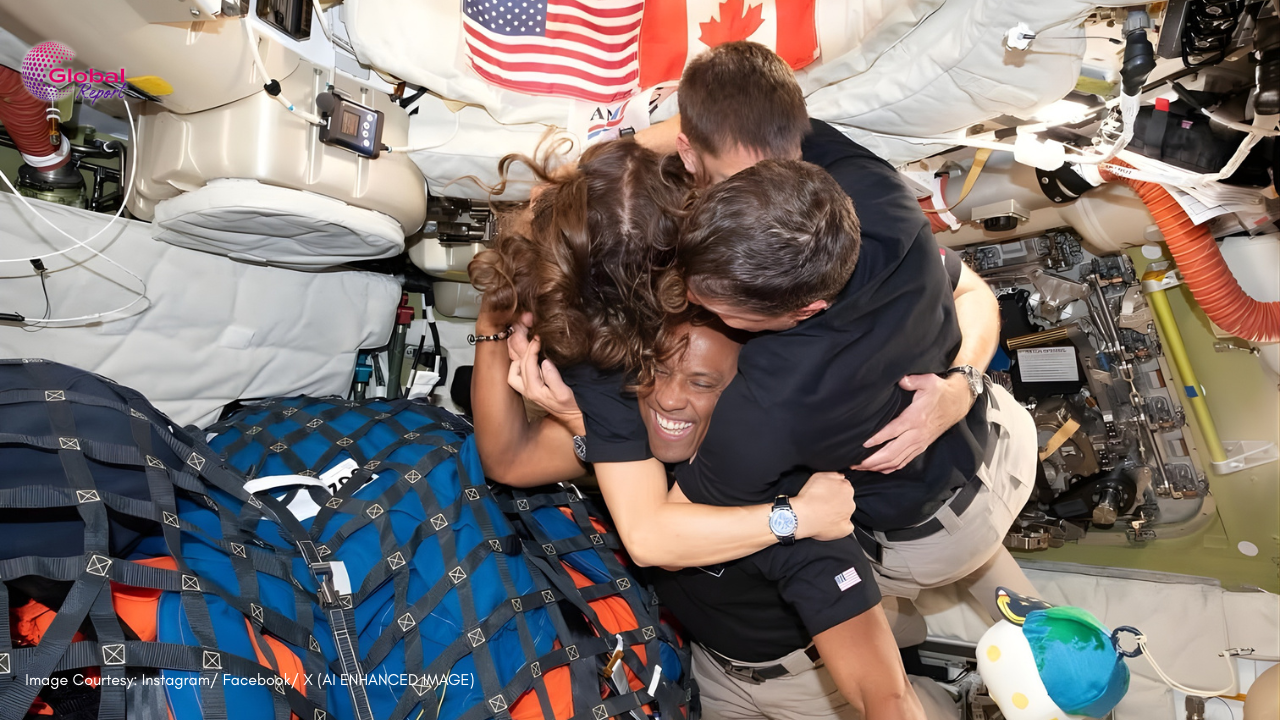
On board were NASA astronauts Reid Wiseman, Victor Glover, and Christina Koch, along with Canadian astronaut Jeremy Hansen. Together, they represented the most diverse crew to ever travel to the vicinity of the Moon.
Wiseman served as mission commander and kept spirits high throughout the journey. Minutes before re-entry, he radioed mission control: “We got a great view of the Moon out window 2 — looks a little smaller than yesterday.” The response from Houston was brief and memorable: “Guess we’ll have to go back.”
The crew launched just over a week before their return. They lifted off from Kennedy Space Center in Florida, embarking on a 10-day journey that took them farther from Earth than any humans since the Apollo era.
Historic Firsts That Rewrote the Record Books
Artemis II didn’t just revisit the Moon — it created new chapters in space history. Victor Glover became the first person of colour to travel around the Moon, Christina Koch the first woman, and Jeremy Hansen the first non-American. Three groundbreaking milestones in a single mission.
During the journey, the crew witnessed phenomena rarely seen by human eyes. They observed a solar eclipse and meteorite impacts on the lunar surface, reporting vivid details about the Moon’s features along the way.
NASA also maintained a daily tradition that added a human touch to the mission. Every morning since the astronauts’ departure, NASA sent a wake-up song to the crew. On the final day, they awoke to Live’s “Run to the Water” and Zac Brown Band’s country hit “Free.”
Mission commander Wiseman reflected on the deeper meaning of the mission. He said that what the crew “really hoped in our soul” was that for just a moment, the world would pause and remember that Earth is “a beautiful planet in a very special place in our universe.”
The Science Behind the Mission
Artemis II was never just about the spectacle. It was a critical engineering and science test flight. The return provided key data on the performance of the Orion capsule’s heat shield, navigation systems, and life-support technology — all essential for safely carrying humans deeper into space.
The Orion spacecraft, built by Lockheed Martin, demonstrated it could safely withstand the intense conditions of a lunar re-entry. That was one of the mission’s core objectives. Engineers will now spend months analysing every data point collected during the flight.
The brief communication blackout during re-entry was one of the most challenging phases of the journey. Caused by extreme heat building up around the spacecraft, it was a known risk — and the crew passed through it without incident. That result alone gives NASA significant confidence heading into future missions.
The mission also reaffirmed that NASA’s Space Launch System (SLS) rocket — the most powerful ever built — and the Orion capsule together form a reliable architecture for deep space travel. This validation was critical for building public and congressional confidence in the broader Artemis program.
What Comes Next After Artemis II?
With Artemis II successfully completed, NASA’s attention now turns to the next phase of the program. Artemis II is widely seen as a critical stepping stone for future Moon missions, particularly Artemis IV, which aims to land astronauts on the lunar surface for the first time since the Apollo era.
Artemis III, currently in development, is expected to be the first mission to actually touch down on the Moon. If it succeeds, it will end a more than 50-year gap since humans last walked on the lunar surface during Apollo 17 in 1972.
The broader Artemis program is also designed to establish a sustained human presence near the Moon, including the planned Gateway lunar space station. NASA is working with international partners, including the Canadian Space Agency — whose astronaut Hansen was part of this historic crew — along with the European Space Agency and Japan.
The success of Artemis II sends a clear message: NASA is no longer in the planning phase. The agency is executing. The return trip to the Moon is no longer a distant ambition — it is a scheduled event.
For space enthusiasts, scientists, and casual observers alike, the next few years promise to deliver some of the most extraordinary moments in human exploration since the original Moon landings. Artemis II has set the stage. The real show is just beginning.
Follow NASA’s upcoming mission announcements and mark your calendars — humanity is going back to the Moon, and this time, it’s staying.
#ArtemisII #NASA #MoonMission #SpaceExploration #Splashdown


